





Chesterfield Group: The Prequel
Robert George, Managing Director
CHESTERFIELD GROUP
The Chesterfield Group offers strategic advisory services to Boards of Directors and to CEOs, with central areas of focus on Business Models and Collaborative Business Structures. What follows will attempt to explain the underlying philosophy of what we're about and clarify this seemingly unlikely pairing of focus areas.
Observations on Structure and Process
After retirement a few years ago, I had the time to thoughtfully reflect on 30 years of business experience, which allowed me to make several interesting observations that are relevant to this discussion:
- The first observation is that every business has both structural and process characteristics. The structure is the path on which its employees are running as hard and as well as they can, and the running represents the process. Sometimes the runners can see a definable goal at the end of the path, and sometimes they are just running.
- The second observation is that choosing the right path and running well are equally important to success, but they are separate and distinct. That analogy carries over to structure and process. Structure is what a company is, and process is what it does. Processes energize the structure and bring it to life. Structure and process are both absolutely critical, and they are complementary, not competing, aspects of any company. The best runners won't succeed, if their path leads nowhere, and poor runners even on the best of paths will be trampled by competing runners. You will see the theme of structure and process permeating this paper and through all the work we do. We believe that failing to make this distinction allows considerable opportunity for any company to under perform.
- Third, while readily recognizing in principle the importance of structure, the focus of most business people is on process. While there may be many others, I have observed three reasons for this:
- The "crisis of the day" takes precedence because of its urgency;
- Individuals in most companies are valued primarily because they are "producers". "Builders", who are the ones working on structure, are often regarded as unproductive overhead because the benefits of their efforts are achieved over too long a term to be readily apparent to the runners; and
- Most employees (correctly, I think) leave the responsibility of structure to their CEO.
- The fourth observation is that Boards of Directors are under pressure from Sarbanes-Oxley and the events leading up to its passage to tighten up their oversight of the CEO. This means, among many other things, that they need to assure themselves, on behalf of the shareholders, that the CEO is on top of the company's structural development, as well as its process development. This includes the Business Model, which is the structural part of the answer to the question: "How do we get from where we are to where we want to be?" Whether it's managing but not owning hotels (see below) or giving away razors to sell blades, every company should have a clear picture in terms of both structure and process of how it goes about its mission in a way that benefits the various constituents it serves.
- One final observation is the most surprising to me: The attention given to structural matters seems to be inversely proportional to their importance. In other words, developing and updating the fundamental structure of the company itself is typically given the least amount of attention of all structuring issues. Are you skeptical? Here's a story about a huge com-pany-one of the best known brands in the world and possibly the largest player in the hospitality space. About twenty years ago, they found their growth curve flattening, and they were moved to get their senior manage-ment team in a room to brainstorm for a day about this. Fortunately, the meeting was chaired by an outsider who was not constrained by too much knowledge of the status quo. They spent the morning answering the ques-tion, "What do we do?" After filling the walls with their thoughts, they be-gan to see that it all boiled down to two things: (1) owning (hotel and re-sort) properties and (2) managing those properties. At the afternoon ses-sion, they worked on the question, "What strengths do we bring to our two activities?" Again, the walls filled with ideas about what they brought to the task of managing the properties, but they had trouble coming up with any real competitive strengths that they could bring to the ownership activ-ity. Their investment money was no cheaper or more available than lots of other companies. As of that day, one of the most successful companies on the planet completely changed its fundamental Business Model. From that day forward, they were a management company, leaving the investing to others, and they have been wildly successful in their growth efforts since then. How could such a fundamental analysis have been overlooked all those years? Here are a couple of possible reasons:
- Perhaps there was a feeling that they shouldn't tinker with some-thing that seemed to be working-at least, until they perceived that it wasn't working as well.
- Perhaps they relied on the CEO for such fundamental thought, but he just wasn't structure oriented. This is pretty common, since many CEOs have climbed the ladder to that position by being a great "producer" (process), rather than a "builder" (structure).
Separation of functions and activities
Hearing the story about the hospitality company separating investing and management was a seminal moment in the development of the Chesterfield philosophy. With newly opened eyes, I began to see opportunities for a similar type of thinking by separating the functions and activities of a com-pany, examining each in light of the company's competitive strengths / con-straints and recombining them in different ways. From there, it was a small step to consider the separation of functions and activities of more than one company and recombining them with each other in still other ways and in new entities. The tools exist to split up capital, expertise, labor, manufac-turing capability, intellectual property, etc., in whatever way best plays into the strengths of a company, and doing so opens up many intriguing structuring possibilities.
While these thoughts are not new, it appears to me that they are often under-appreciated. Evidence of this is the continued widespread use of mergers and acquisitions to fill capability gaps. Doing so, however, is such a blunt instrument that using it usually does more harm than good, resulting in the consistently poor success statistics on M&A over the years. If the acquiring company can set out precisely what they see of value in the target company, the chances are excellent that alternatives to M&A can be found to acquire the missing capability without acquiring the entire company-alternatives that remove from the situation virtually all the reaons for most M&A failures. Finding those opportunities, through the process of (1) analyzing strengths, constraints and corporate goals and (2) separating and recombining of functions or activities is central to what the Chesterfield Group does.
Business Models
The Business Model, as described above, might be simply presented as follows:
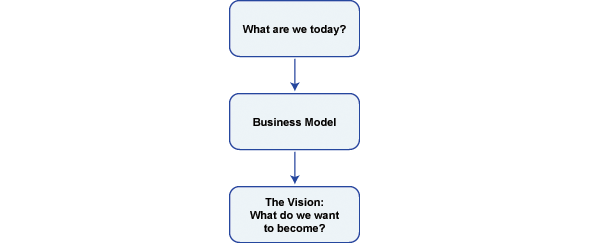
Developing the content for each of these boxes represents a meaty topic:
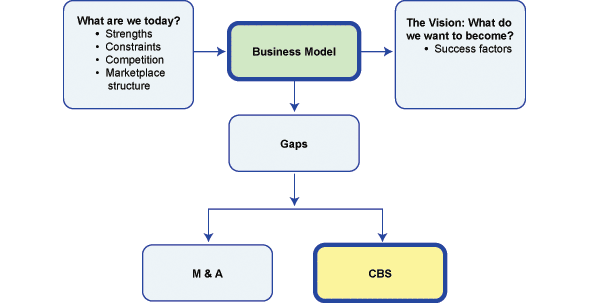
- The top box describing what we are today contains a lot of information and is relatively fixed for the near term. If it hasn't already done so, every company should, for lots of reasons including this one, go through the process of filling in this box. Some of the things that might go into this box are shown in the version of the picture below.
- The Business Model is not something that we just dream up-it is a function of the boxes on either side. It is the structural answer to the question of how we get from where we are to day to the Vision of tomorrow. The "process" part of the answer to that question is often called a Business Plan, as opposed to a Business Model. They're both important, but they are two different things.
- The Vision box (What we want to become), however, is very different. We do get to dream it up! It can be virtually anything the CEO and Board want it to be and needs to include a list of the factors required to achieve it. Deciding what to put into the Vision box will likely be an iterative process. Given the company we are today, we can try many different Visions and develop a Business Model to get us from where we are to each Vision. Then we repeat the process with different Visions until we bring our dreams into reasonable balance with practical reality (Ah, you knew there was a catch!), until we're satisfied with the result.
Collaborative Business Structures
One of the most interesting things about going through this iterative process is that gaps in our ability to bring what is necessary for a given Business Model and Vision are immediately apparent. The gaps are sometimes insurmountable, and the corresponding Vision must be abandoned. However, there will be other times when the gaps can be filled through collaboration with another company, through a partnership, joint venture, licensing agreement, etc. The Chesterfield Group uses the term Collaborative Business Structures (CBS) to describe these structures as a group. This realization has led the Chesterfield Group to its second major focus, the recognition, structuring and deployment of Collaborative Business Structures. The picture below will help to place CBS in the context of our previous discussion of Business Models. Please note that mergers and acquisitions are also shown, since they are a common response to Business Model gaps, and also to make it clear that CBS should be seen as alternative to M&A in that respect.
For information about Chesterfield Group and our efforts to help CEOs and Boards of Directors focus on better structuring, please contact us at the numbers below or visit the web site at