





M & A Paradox
Robert George, Managing Director
CHESTERFIELD GROUP
Over the last several decades, mergers and acquisitions have become a staple of American business as a way to expand into new markets, add products to existing offerings and fill capability gaps of all sizes and descriptions. Notwithstanding all those years of experience, however, mergers and acquisitions generally don't work very well. Generally speaking, more than two out of every three fail—and do so in a rather short amount of time.
The M & A Paradox is: Why does an activity with such a low level of success continue at such a high level of activity over such a long period of time? The question can be examined in several parts:
- What causes the failure rate to be so high?
- If we know the reasons behind the failures, why do we keep making those same mistakes?
- If there are explanations, why we can't seem to avoid the mistakes? Why do we keep doing M&A?
Causes for the high failure rate
The primary reasons seem to be various forms of the following:
- Culture fit: When two companies become one company, two cultures must become one culture. Usually, only one of the two survives, and the other dies out, with predictable results. Sometimes, this works, but usually the people coming from the deceased culture become unhappy. Often they leave. If those that stay were successful in the old structure, they tend to be less successful in the new culture to whatever extent they are slow to adapt. In the case of an acquisition, the company being acquired is usually the one that loses the culture battle. If its employees leave or become less effective, it is likely that the whole project will fall short of expectations and add to the poor statistical outcome of M & A.
- Paid too much: Since statistics enjoy the benefit of hindsight, it should be no surprise to find this issue high on the list. If the buyer had known at the time he entered into the deal the things he knows after a couple of years, he might not have paid as much or done the deal at all. Paying too much puts great strain on the resulting combined organization to generate returns to justify that price. Failing to generate those high levels of return will generate yet another bad M & A statistic.
- Employee motivation: In addition to the employees mentioned earlier who are challenged to make the transition to a new culture, there are also cases where a particular employee perhaps the founder of the acquired company is key to the success of the company under its new ownership. As an employee under the new arrangement, such a person can lose some of the motivation that drove him to success as an owner. In some cases, that can lead to an under achieving result.
Why can't we avoid the mistakes?
- It's the other guys: For some reason, bad statistics apply to other people. Humans are famous for engaging in all manner of risky behavior, based on their implicit acceptance of this obviously flawed logic. In this case, (goes the rationale), the participants have thought through every possible angle, and, notwithstanding the overall poor success rates, they are presenting a project with an extremely high probability of success.
- Can't see the future: Things never turn out quite the way the participants project them, and that could explain some part of the failure rate. It does seem, however, that the projections could be sufficiently conservative to be right more than one time out of three. Perhaps we can explain such an outcome, at least in part, by pointing out that the individuals constructing the projections are generally members of the deal team. They are optimistic about the deal, and they are invested in its success.
- A life of its own: A lot of time is required to put together a merger or acquisition, and much of that time is contributed by very senior and expensive people. The further along the time line the deal gets, the more momentum is generated, and the harder it is for people to raise major criticisms. The job of the deal team gradually changes from one of objective valuation to one of advocacy. It is just human nature for people to want to be team players and not troublemakers whose comments could be viewed as contrary to the efforts of the team. As time goes on, the members of the team get increasingly invested in the deal, making it increasingly hard for them to raise a caution flag that might bring the whole project to a "bad" end—even though doing so could be in the shareholders' interests.
Then why do we keep doing mergers and acquisitions?
- The end justifies the odds: Notwithstanding the statistically low likelihood of success, the visions that initially move a company to think in terms of a merger or acquisition are usually extremely compelling. They are as many and varied as there are ideas, but they are clear and they are strong. In many cases, participants are unprepared to abandon the powerful vision in the face of the obstacles of culture fit, price, etc. Rather, the participants' desire to do the deal and realize the vision allows them to rationalize these obstacles away, in part because the obstacles primarily apply to the "other guys" and in part because deal participants develop strategies to overcome the obstacles. In short, they believe that they can beat the odds of the "average" deal because both this particular deal and this particular deal team are above average.
- Glory, money and testosterone: The rewards of money and status don't flow as rapidly to those individuals who (correctly) kill deals that should never be done than to those who do get them done even deals that are later discovered should have been avoided. This is generally true of the participants that are company employees, as well as of their deal advisors, who are (1) initially chosen in large part because their resume shows a large number of deals they have completed (but fails to mention a single deal that they correctly killed) and (2) paid when the deals are closed.
- Just looking: Deal participants initially feel that there couldn't be any harm in "just studying the possibilities". They feel that they will be completely objective and free to back away, based on what they see. Once they start getting invested, however, it simply isn't that easy. As noted above, deals have the strong ability to take on lives of their own.
What can we do better?
These options come to mind:
- Stay the course: Perhaps participants can have more discussions about the pitfalls described above and try to do a better job providing for them. In the end, however, this option boils down to the existing rationale: If the vision is good enough, it's worth the risk of failure.
- Abstain: We can abstain from M & A activity, on the theory that the statistics are too dismal for us to consider it a viable strategy for reaching our goals.
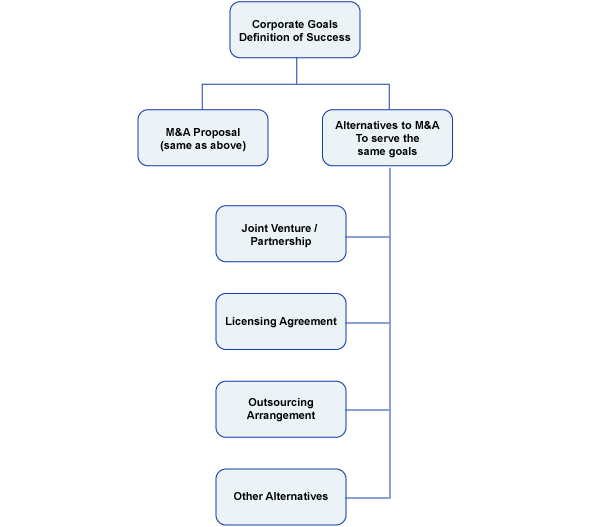
- Consider M & A in the context of alternatives: For each transaction, we can explore the possibility that there might be alternative structures to a merger or acquisition that would fulfill the vision, without exposing ourselves to the problems that bring down most M & A deals. Examples of these structures could be joint ventures, licensing agreements, partnerships, outsourcing, leasing and management agreements. None of these structures involves a change in ownership with the resulting exchange of large sums of money, loss of culture, etc.
More on option 3...
Mergers and acquisitions will undoubtedly continue to play a significant role in corporate strategy going forward. However, in many circumstances, there may be opportunities to utilize other available options for accomplishing the goals of the merger or acquisition options that are not burdened by the issues detailed above.
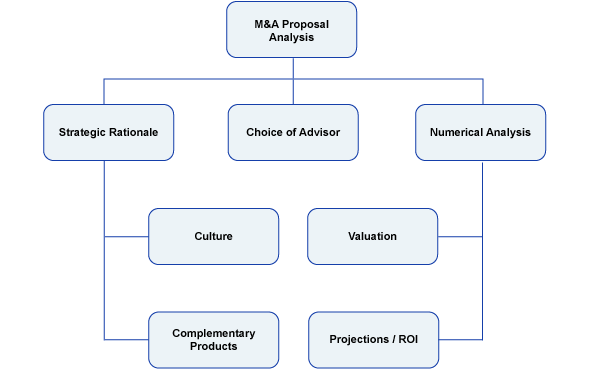
To graphically describe this approach, the chart below might represent a typical analysis of an M&A transaction:
The third approach above suggests a supplement tosupplementing that analysis by placing it in a context that might resemble the following chart:
As you think through your options, there won't always be one that will improve on the original idea, but sometimes there is. And for those times, your share holders could significantly benefit from the effort from fully evaluating them.
CHESTERFIELD GROUP
The CHESTERFIELD GROUP has a great deal of experience putting together structures that help companies achieve mutual, shared goals. From that experience, we have distilled a number of principles that help us methodically surface alternative structures to achieve those goals while minimizing the potential for unpleasant side effects that so commonly accompany traditional merger and acquisition solutions.
For more information, please refer to our web site at
Please contact us, if we can be of assistance or if we provide you with more information.